
Abstract
This chapter, available only on this companion website, explores how to embed Education for Sustainability (EfS) within PGCert design and delivery. Recognizing that EfS can be a strong curriculum driver or an emerging theme, I review why this matters and offer practical strategies to integrate it into your PGCert. The chapter navigates the opportunities and tensions of embedding EfS, encouraging your PGCert to model a commitment to more ecological learning.
Depending on your institutional ‘flavour’, priorities and context, Education for Sustainability (EfS) may be a strong curriculum driver and element or may be an emerging theme. Either way, the PGCert should model a commitment to more ecological learning and this should be reflected in many aspects of the provision. In this chapter, I will review why this matter and how, in practice, we can start to make it happen on PGCert.
The Why
Sustainability is a unifying thread that should be woven throughout higher education. As Young (2024) notes, ‘climate and environmental concerns are at the top of the list of current societal concerns’ and universities are expected to ‘feed sustainability, adaptation and ecology into many or all university courses’. This imperative is not only environmental but also social and economic, asking of universities to act as ‘social connectors, knowledge brokers and innovators for sustainability’ (Leal Filho et al., 2025). Over three decades ago David Orr wrote: ‘All things considered, it is possible that we are becoming more ignorant of the things we must know to live well and sustainably on the Earth’ (Orr 1992) and yet today those words are more relevant than ever.
The UN Sustainable Development Goals (SDGs), particularly Goal 4.7, highlight education’s role in achieving sustainable development by ensuring that all learners acquire the knowledge and skills needed to promote sustainability and global citizenship. Higher education institutions should integrate these principles to nurture ecologically literate citizens prepared to address local and global challenges. This applies to the PGCert provision as well.
I invite you to think about these prompts:
Activate your inner dialogue… How would you answer in your context?
How can EfS be embedded throughout PGCert courses?
How can PGCert facilitators model ecological learning and practices to encourage participants to integrate EfS into their own disciplines and practices?
Embedding education for sustainability (EfS) in the PGCert matters because it equips higher education educators with the skills and mindset to address one of the most pressing global challenges of our time: achieving sustainable development. PGCerts are well-placed to shape educators’ values and practices at a formative stage. Besides, the interdisciplinary nature of PGCert cohorts also mirrors the collaborative, cross-disciplinary approach required to address sustainability challenges.
The roots-to-shoots model, introduced in Chapter 2, identifies nine foundational values for inclusive practice, with the ‘ecological root’ representing sustainability as a core principle that should inform all aspects of teaching and learning. As emphasised in that chapter, ecological PGCert design goes beyond environmental sustainability; it embodies a holistic, values-driven approach that integrates sustainable principles into all aspects of learning.
‘Ecological’ is understood here as the relationship between living organisms and their environment. This broad meaning embraces efforts to positively impact all the ecosystems we are part of. It is a value that should shape behaviours and practices. Barnett (2018), in his seminal work The Ecological University, describes it as a ‘feasible utopia’, an intentional and ongoing process. Barnett’s framework includes seven ‘zones’: knowledge, learning, culture, persons, society, economy and the natural world. He argues that the financial zone often overshadows the others, limiting universities’ broader ecological roles. Instead, he calls for universities to actively engage with the Earth and SDGs, embodying universality and ecological responsibility.
Embedding EfS is about ‘empowering students with the knowledge, skills and attitudes to address wicked challenges like climate change and inequality’ (Kukuczka, 2025). Without this, ‘we risk graduating students unprepared for the challenges of the 21st century’ (Kukuczka, 2025). Because of the complexity of ecological issues, EfS is also connected to cultural pluralism which values and integrated diverse perspectives, including first nations’ knowledge systems. As Blessinger, Singhand Rao (2024) discuss, cultural pluralism in education can empower students to be culturally competent, environmentally conscious and socially responsible citizens. Starting from this perspective, the PGCert can prepare educators to address sustainability within their diverse and globalized learning environments.
EfS also aligns with the Inner Development Goals (IDGs), which articulate essential human qualities needed to achieve sustainable development goals:
Being: Cultivating self-awareness and a relationship to self.
Thinking: Developing cognitive skills to address complex challenges.
Relating: Caring for others and the planet.
Collaborating: Building social skills to work with diverse groups.
Acting: Enabling change through informed and responsible decision-making.
These qualities complement established sustainability competencies such as those outlined by UNESCO and the SDGs, but place particular emphasis on the inner capacities and dispositions that underpin effective action (Inner Development Goals, 2024).
As discussed in chapter 4 (Learning Content: Input and Practice), in the PGCert context, these qualities are not developed in isolation but are woven through course delivery, peer dialogue and assessment. For example, reflective journaling and peer review/feedback enhance self-awareness and critical thinking while interdisciplinary group projects develop collaboration and relating. In the case of EfS, by intentionally embedding opportunities to nurture these inner capacities, the PGCert supports participants to move beyond knowledge acquisition towards the mindsets and capabilities needed for sustainable change in their own educational practice. While the IDGs are one of several frameworks available, their focus on personal and interpersonal development offers a valuable complement to more outcome-oriented models.
It is important to distinguish between education and advocacy when embedding Education for Sustainability (EfS) in the PGCert. While EfS necessarily engages with urgent global challenges and values, its role in higher education is not to prescribe a single worldview or set of actions, but to promote critical thinking, dialogue and intellectual autonomy. This means presenting sustainability as a complex and contested field, encouraging participants to examine multiple perspectives, including those that challenge mainstream sustainability narratives and supporting them to make informed, reflective decisions relevant to their own disciplines. By modelling open, critical inquiry, EfS in the PGCert context empowers educators to engage with sustainability in ways that are context-sensitive and professionally responsible, rather than simply advocating for predetermined solutions (Wals & Jickling, 2002).
However, this is not easy and straightforward. Resistance to EfS often stems from misconceptions that it is irrelevant to certain disciplines or an added burden within packed curricula. There may also be institutional hesitancy to adopt transformative practices, particularly when sustainability is misunderstood as a niche or optional concern. Another concern is greenwashing and the use of EfS as a marketing strategy only.
To address these challenges, PGCert courses should incorporate EfS in ways that directly relate to various disciplines, showcasing its relevance across fields because EfS is most meaningful when it is ‘genuinely integrated’ and ‘connects deeply with the disciplines students have signed up to study’ (Advance HE, 2024; Pratt-Adams et al., 2025). As Higgins and Calvert (2025) argue, ‘there is a need for genuine integration of EfS into university curricula to engage students and equip them with the necessary competencies to…empower them to be true advocates of change’.
Institutional Context
Universities are uniquely positioned to act as catalysts for sustainable development, influencing not only individual learners but also societal norms and practices (Leal Filho et al., 2025). Many institutions already engage with sustainability initiatives, such as green campus projects, sustainability strategies and community partnerships. Embedding EfS in the PGCert aligns with these efforts, reinforcing consistency between institutional strategies and practices and pedagogical approaches. This integration can also support related institutional priorities like enhancing student employability and promoting interdisciplinary collaboration.
On the other hand, sustainability strategies often don’t translate directly into pedagogical requirements for PGCerts. Many PGCert facilitators and participants may lack formal training or confidence in teaching EfS concepts. They might feel unqualified to address complex sustainability issues, particularly those outside their immediate disciplinary expertise with the added risk of touching on a potentially politically divisive topic. Without clear top-down support or dedicated resources (for faculty development and curriculum redesign), EfS integration can remain an individual, rather than systemic, effort.
The case study from the University of Salford, already mentioned in Chapter 8, illustrates how EfS can be embedded through collaborative approaches on PGCerts. In redesigning the PGCAP, colleagues from the Sustainability Office, Library, Disability and Learner Support and other departments co-created topics and activities that integrated sustainability into pedagogical practices. This collaboration not only highlighted the connections between EfS and active learning but also modelled interdisciplinary cooperation, demonstrating how sustainability can be authentically embedded across diverse contexts (Morley, 2025).
Creating space and structure for critical reflection is ‘key to developing values which mobilise sustainability knowledge and competency into action’ (Advance HE, 2024). EfS is a ‘wicked (nexus) problem that cannot be addressed by one discipline alone, but needs a plurality of perspectives within and beyond academia’ (Wonkhe, 2024). As Macintyre et al. (2025) remind us, ‘there are no blueprints for this immense endeavour; instead we must explore and learn our way out of unsustainable living’.
Internally, guidance may be available through sustainability committees, professional development resources, or collaborations with third-space professionals. However, PGCert participants need support to integrate sustainability into their own contexts, including access to resources, training and case studies that demonstrate its relevance across disciplines.
In the following narrative, Pamela Styles reflects on her experiences as a Learning Manager at a nature reserve, where she adopted enquiry-based learning approaches to promote sustainability education. Notice how she connects these approaches to PGCert pedagogical principles and practices, to instigate lasting impact.
Pamela Styles on ‘Capitalising on the inherent attributes of PGCert programmes to effectively embed Education for Sustainability’
In my role as Learning Manager at a nature reserve, my team and I adopted enquiry-based learning (EBL) approaches to encourage children visiting the site to make and interpret observations, working collaboratively in a transdisciplinary context, where they were able to visualise what the concepts they were learning about in school might look like in practice in the real world. This approach is widely recognised as lending itself well to sustainability learning (The Quality Assurance Agency for Higher Education and Advance HE 2021; Hadjichambis et al. 2020).
However, EBL approaches call for a considerable degree of learner control and choice. Learners can only meaningfully engage with this process if they have sufficient knowledge and experience to draw on prior to the session taking place. This presents the challenge of balancing learner freedom and exploration with scaffolding the experience sufficiently to promote meaningful learning. We achieved this by providing access to curated information and resources, along with prompt questions for reflection as part of facilitated discussions, asking challenging open questions to promote and advance critical thinking.
Often, these discussions would be facilitated by volunteers without specialist expertise. However, with sufficient grounding in basic concepts, volunteers were able to facilitate meaningful learning experiences by asking carefully constructed questions to stimulate reflection, observation, analysis, extrapolation and the formation of informed judgements and solutions. This could be achieved by encouraging the children to relate their observations to their own areas of interest, drawing on prior learning of which the facilitator did not need to be aware, to arrive at a unique interpretation of relevance to the individual. This grants the learner some independence, but within an intentionally scaffolded and facilitated learning experience. By modelling the process of effective questioning, we can equip learners to begin to do this effectively for themselves, drawing on their own frames of reference.
The objective of these hands-on, collaborative learning experiences was to stimulate lasting changes in children’s values and behaviour with respect to environmental conservation, but the extent to which a single learning event can trigger this is limited. It will hopefully spark learners’ interest, but a school trip to a nature reserve is just the beginning, and, realistically, can only effectively form part of the ‘engagement’ aspect of EBL (Pedaste et al. 2015).
Our evaluation of the impact of these visits suggested that lasting, meaningful learning was only achieved through sustained engagement, particularly by returning to the reserve multiple times, and by the teacher using the trip to launch a topic incorporating sustainability themes back in school. The importance of sustained engagement is represented in the literature on education for sustainability (EfS) (e.g. McCowan 2021), as is the need for explicit connections to be made between the learning experiences and sustainability concepts, with sustainability competencies ideally being developed within relevant real-world contexts (e.g. Demssie et al. 2023).
Many of these principles – ongoing engagement, authenticity, explicit connections to sustainability, and facilitated discussions that support learners to derive meaning that is relevant to them – apply to EfS generally, including effectively embedding it into PGCert courses.
As with the school trip context, we only have PGCert participants with us for a short time and need to consider how to spark their interest and equip them with the knowledge, skills and confidence they need to continue their journey of embedding sustainability into their own curricula after they graduate. Fortunately, PGCert courses foster a learning environment that lends itself well to the development of sustainability competencies, such as regular opportunities to engage in reflection and collaboration, drawing on diverse perspectives and experiences. This is enhanced further with interdisciplinary cohorts, where the learning experiences we provide can actively demonstrate the benefits of collaboration beyond participants’ own subject areas.
These attributes align with research into effective approaches for embedding sustainability into courses (The Quality Assurance Agency for Higher Education and Advance HE 2021). However, simply exposing participants to these learning environments is insufficient. They need to engage with these opportunities – interdisciplinary collaboration, exploration of real-world case studies and scaffolded reflective practice – in contexts that explicitly link to sustainability.
Curated information about effective sustainability education, including examples of what this looks like in different disciplines, can help participants to visualise the relevance to their own curricula. These are, however, unlikely to be tailored to participants’ individual contexts, and without further support, teachers may struggle to apply these principles in their own practice. Upskilling those who teach on PGCert courses can build their confidence to effectively facilitate discussions and interactive activities, supporting teaching staff to embed sustainability in meaningful ways.
We have approached this in a similar way to the PGCert course itself, by sharing curated background information relating to key principles and techniques, engaging in scaffolded, facilitated discussion using reflective questioning, and by supporting individuals on an ongoing basis to apply this to their specific contexts. The aim is to equip Academic Developers to apply their expertise in reflective practice and effective questioning to facilitate discussions in which participants draw on their own knowledge and understanding of their discipline to devise solutions to embed sustainability into their curricula. These discussions should challenge participants to go beyond their initial ideas, considering, for instance, the interconnectedness and potential conflicts between the different ‘pillars’ of sustainability, such as exploring the environmental, social and ethical implications of Generative AI alongside its economic potential (Crawford 2021), ultimately shaping meaningful learning experiences that go beyond a ‘greenwashed’ curriculum.
Just as learners are only likely to experience changes in values and behaviour following ongoing engagement with sustainability concepts, we need to consider how we might foster the same for PGCert participants. For instance, embedding sustainability throughout the PGCert course will increase the likelihood of them applying their skills in practice. Beyond that, as with children visiting a nature reserve, achieving lasting impact will be more likely if engagement continues beyond the course. We might achieve this by, firstly, fostering meaningful relationships with and between participants to promote ongoing collaboration, such as inviting each other as guest lecturers to expose students to interdisciplinary perspectives on sustainability-related topics. Secondly, we can provide ongoing CPD opportunities relating to EfS that draw on real examples of practice shared by their peers – including former PGCert participants. Hopefully, the relationships formed and the interest sparked during the PGCert will make teachers more likely to engage with these opportunities as part of their ongoing EfS journeys.
References
Crawford, K. Atlas of AI: Power, Politics, and the Planetary Costs of Artificial Intelligence, New Haven: Yale University Press, 2021.
Demssie, Y. N., Biemans, H. J. A., Wesselink, R., & Mulder, M. (2023). Fostering students’ systems thinking competence for sustainability by using multiple real-world learning approaches. Environmental Education Research, 29(2), 261–286. https://doi.org/10.1080/13504622.2022.2141692
Hadjichambis, A.C., Paraskeva-Hadjichambi, D. (2020). Education for Environmental Citizenship: The Pedagogical Approach. In: Hadjichambis, A.C., et al. Conceptualizing Environmental Citizenship for 21st Century Education. Environmental Discourses in Science Education, vol 4. Springer, Cham. https://doi.org/10.1007/978-3-030-20249-1_15
Margus Pedaste, M., Mäeots, M., Siiman, L.A., De Jong, T., Van Riesen, S.A.N., Kamp, E.T., Manoli, C.C., Zacharia, Z.C., Tsourlidaki, E. (2015). Phases of inquiry-based learning: Definitions and the inquiry cycle. Educational Research Review. 14:47-61. https://doi.org/10.1016/j.edurev.2015.02.003
McCowan, Tristan (2021) Climate Change in Higher Education: a curriculum topography approach, Transforming Universities for a Changing Climate, Working Paper Series No. 6 ISSN: 2754-0308
The Quality Assurance Agency for Higher Education and Advance HE (2021). Education for Sustainable Development Guidance.
Inclusivity Note
Sustainability and inclusivity intersect by emphasizing equity, collaboration and the incorporation of diverse perspectives to address global challenges meaningfully.
Challenge: Operationalising EfS on PGCert is not easy. Ensuring that sustainability concepts are accessible and relevant to participants from a wide range of disciplines and contexts can be difficult, particularly when addressing diverse needs and levels of prior knowledge.
Top Tips:
Embed sustainability as part of the PGCert’s ecological ethos, integrating it holistically rather than treating it as an isolated topic.
Use real-world, interdisciplinary examples to make sustainability relatable across disciplines. Encourage participants to bring their own disciplinary contexts and examples to the discussion, rather than relying solely on pre-selected curated examples.
While the context of a nature reserve is different from a PGCert classroom, the case study serves as an inspiration and as an example of cross-pollination where higher education practices can be informed by other sectors’ practices. The underlying pedagogical principles, such as enquiry-based learning, scaffolding and critical reflection, are highly relevant to higher education. The key lesson for PGCert design is to adapt these strategies: for example, by providing structured opportunities for enquiry into sustainability issues, supporting participants with curated resources and modelling effective questioning. In the PGCert, this might mean designing manageable, discipline-relevant activities that prompt critical thinking and reflection and ensuring that facilitation is context-sensitive.
Pamela mentions the need to create sustained opportunities throughout the course so that EfS becomes a thread through the PGCert and she emphasises both the challenges and transformative potential of this work. Students are already ‘implicitly treated as prospective custodians of their discipline,’ and EfS ‘doesn’t take students away from their discipline but draws deeply on it’ (Wonkhe, 2024). Ecological literacy is a way to prepare PGCert graduates to bring their enhanced EfS understandings to their cohorts where their students can also bring it to the world beyond academia.
The How
As discussed in Chapter 2 and reinforced in the narrative above, to embed education for sustainability, it needs to be introduced early, alongside discussions of other educational values, to establish it as a core value. Revisiting it during sessions on pedagogy, curriculum design and assessment allows participants to contextualize and apply sustainable practices.
Community engagement is also vital for EfS, for instance collaborations with local organizations or NGOs can enrich learning and demonstrate the impact of sustainability-driven education.
In the following narrative, notice how Leisa Nichols-Drew demonstrates the integration of sustainability into PGCert curriculum and practice. Her reflections shows the importance of embedding Education for Sustainable Development (ESD) within institutional strategies and teaching frameworks to resonate across disciplines.
Leisa Nichols-Drew, Associate Professor and DMU UN Academic Impact SDG Hub Fellow, De Montfort University, on ‘Integrating sustainability into curriculum and practice’
De Montfort University (DMU) has the ethos of being ‘The Empowering University’, which aims to empower students, colleagues and partners in the creation of a fairer society. Sustainability is at the core of this vision and forms one of the cross-cutting themes within the institution along with the Learning for Life strategy pillar. Additionally, DMU has undergone a significant transformation in its approach to educational delivery by implementing a block curriculum. The Advance HE-accredited PGCEE (Post Graduate Certificate in Empowering Education) at DMU enables colleagues to experience an entire block module focused on Education for Sustainable Development (ESD), where they embrace varied concepts and align them to their diverse subject practice areas. To coincide with the block curriculum, a sustainability workstream project has initiated a new perspective, with the ultimate aim of connecting colleagues and their students to ESD within their own diverse subject disciplines and practice areas, including the PGCEE.
The Quality Assurance Agency (QAA) and Advance HE define ESD as the process of creating curricula, including subject-relevant content (QAA and Advance HE, 2021). For the PGCert curriculum, ESD offers a dual consideration. Correia and Kinchin (2022) propose that ESD is a fusion of two concepts: pedagogic resonance and threshold concepts. Pedagogic resonance can be seen as the academic bridge between student learning and teacher knowledge. With colleagues experiencing both of these roles when undertaking a PGCert qualification, Carnell and Fung (2017) propose that aligning learning design, experience and discipline via research-informed approaches is of paramount importance. Furthermore, as contributors to a PGCert curriculum, it can be said that when facilitating sessions, there is an interchange of knowledge and experiences between individuals, regardless of their role as ‘student’ or ‘teacher’.
Numerous authors have previously referred to a ‘beach ball’ when considering the varied perspectives from individuals when they are all focusing on the same issue. Here, it could be suggested that ESD is, in itself, a beach ball, like a colourful ball with multiple segments, each representing a different viewpoint. Depending on where a person stands, they see different colours, symbolising how participants may hold varied perspectives on the same concept. Within the PGCert learning environment, students and colleagues may all see something different. This is visually represented as Beach Ball Viewpoints, a sphere with many different segments (Nichols-Drew, 2023).
Reflecting on my own beach ball viewpoint in relation to ESD, my prior experiences, learning and subject discipline as a practitioner in forensic science had all contributed to my knowledge of the 17 United Nations Sustainable Development Goals (SDGs). Additionally, De Montfort University (DMU) being a global university United Nations Academic Impact (UNAI) hub for SDG 11 Sustainable Cities and Communities; and the previous hub for SDG 16: Peace, Justice and Strong Institutions had further underpinned this knowledge and understanding. However, during the preparation of material for the new DMU PGCEE curriculum delivery, I realised how limited my initial ESD viewpoint had been.
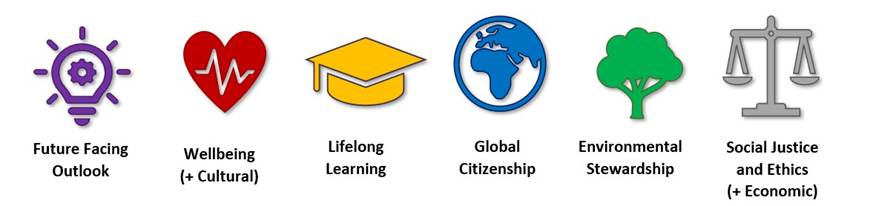
Loring (2020) defines threshold concepts as being critical in enabling the transition into a new discipline or paradigm, with complexity and adaptability linked to ESD. Having experienced my own threshold concept with ESD and to assist my fellow DMU colleagues, an interdisciplinary mechanism for communicating ESD was needed. This took the form of six visual icons, each representing a theme aligned to sustainability. The ‘six sustainability themes’ are represented in Figure 9.1 (Nichols-Drew, 2024). These have been integral in assisting colleagues with the transformative learning process and transition from a liminal space into a new, all-encompassing ESD viewpoint.
Figure 9.1: Six Sustainability Themes – for the DMU Block Curriculum (Nichols-Drew, 2024)
Hussain et al. (2024) propose utilising an amalgamation of pedagogic approaches within the educational setting for successful ESD engagement, including active, experiential, problem-based and transformative learning. Problem-based learning (PBL) correlates with metacognition and autonomy, which evidence the principle of heutagogy, fundamental for a lifelong learning culture. PBL was fundamental in the sustainability block teaching project in engaging colleagues and ultimately students, from across the DMU institution. By utilising contextualised examples as case studies, these have inspired colleagues across the DMU community to embrace ESD using PBL along with the six sustainability themes. For instance, the societal issue of knife crime was demonstrated to the PGCEE cohort using a PBL toolkit resource. This was evidenced in the PGCEE module assessment based on sustainability and has since influenced other colleagues to connect their subject discipline within the ESD arena: ‘your PBL example has inspired us to show how we can also embed sustainability within our own disciplines’.
In conclusion, it is evident that Education for Sustainable Development (ESD) may be experienced as pedagogic resonance and threshold concepts within the PGCEE environment and represented as ‘beach ball viewpoints’. Therefore, it offers both opportunities and challenges. Additionally, by representing ESD as generic themes that are easily identifiable, this can aid the transition into a new and previously unfamiliar paradigm. Furthermore, rather than using a ‘one size fits all’ route for ESD, by championing problem-based learning with real-world examples, this supports alignment with subject disciplines and, ultimately, successful ESD engagement, while reflecting our Learning for Life strategy at DMU.
References:
Carnell, B. and Fung, D. (eds.) (2017) Developing the higher education curriculum: Research-based education in practice. London: UCL Press.
Correia, P.R. and Kinchin, I.M. (2022) ‘Pedagogic resonance and threshold concepts to access the hidden complexity of education for sustainability’, in Higher education for sustainable development goals. Aalborg: River Publishers, pp. 1–22.
Hussain, K., Aman, N., Noor, N. and Shah, Z.W. (2024) ‘Education for sustainable development (ESD): Pedagogical approaches that make a difference’, International Journal of Social Science Archives (IJSSA), 7(1), pp. 106–112.
Loring, P.A. (2020) ‘Threshold concepts and sustainability: Features of a contested paradigm’, Facets, 5(1), pp. 182–199.
QAA and Advance HE (2021) Education for sustainable development guidance. Gloucester: QAA.
Inclusivity Note
Sustainability and inclusivity are intertwined and can both be seen as threshold concepts and practices (or as learning thresholds).
Main Challenge: the main challenge of EfS is overcoming perceptions of irrelevance and integrating it into already dense PGCert curriculum.
Top Tip: if many in the PGCert cohort are new to EfS, provide optional curated resource lists. Besides considering EfS as a value, PGCert participants could start with small, discipline-relevant interventions, discussion, real-world examples and activities to inspire engagement.
Then cross-pollination initiatives and PGCert outputs with a sustainability focus will be better received.
By connecting theory to practice, Leisa illustrates how sustainability can be woven into the fabric of the PGCert, creating meaningful engagement and aiming for lasting impact. In practice, there are a number of ways to embed Education for Sustainability in the PGCert, starting with learning outcomes design and assessment regime design.
EfS can be meaningfully embedded in PGCert courses by aligning some or even all of the course learning outcomes (LOs) for instance through mapping with the 17 Sustainable Development Goals (SDGs). LOs might encourage participants to engage with new paradigms like education for global citizenship and sustainable lifestyles, to promote a wider understanding of sustainability’s role in shaping educational practices.
You don’t need to rewrite your LOs, but you can use sustainability as a lens or context for the activities and reflections they already require. For instance, for LO1 in the scheme of learning I proposed in chapter 4: ‘Design, facilitate and collaboratively peer-review learning activities that actively engage students and foster critical thinking’, EfS can be promoted by asking participants to choose a sustainability related theme or ecological issue (e.g. sustainable cities, ethical consumption) as the context.
Some learning outcomes (including participants’ self-selected ones) are ‘aspirational and will not be assessed for academic credit’. These may include competencies linked to sustainable lifestyles. PGCert practitioners should bring them to the fore, especially where EfS is embedded into disciplinary learning (Vogel et al, 2023).
Incorporating EfS into the assessment regime translates these values into actionable outcomes and outputs. PGCert assessments can prompt participants to design sustainability-focused teaching interventions or critically evaluate how their discipline supports sustainable development. To measure the impact of these assessment outputs, evaluations could combine participant feedback, case studies and institutional metrics, to gather both qualitative and quantitative insights. Longitudinal tracking of how both PGCert graduates and their own students apply EfS in their own professional contexts would demonstrate the sustained impact of the PGCert in this area.
To mitigate the risk of EfS becoming a tick-box exercise, if possible, co-create or adapt learning outcomes and assessments with participants, to make them more relevant and meaningfully integrated rather than simply added on.
I now invite you to think about the following ideas to operationalise embedding EfS in your PGCert context. Take them as food for thought and provocations rather than definitive ‘solutions’.
1. Introduce EfS as a core ethos early
Challenge: some participants may feel EfS is being imposed or is irrelevant to their discipline, leading to disengagement.
Possible solution: frame EfS as a lens to enhance professional practice across all disciplines and invite participants to share initial thoughts or reservations, making space for scepticism and dialogue.
2. Align with institutional and external initiatives
Challenge: institutional strategies may be perceived as performative or disconnected from real practice and external partnerships may not be relevant to all.
Possible solution: select and highlight concrete, successful examples of institutional or external initiatives that have directly impacted teaching and learning and invite participants to critique or adapt these for their own contexts.
3. Model sustainable practices in ‘delivery’
Challenge: eco-friendly actions (such as reducing printing) may seem tokenistic if not matched by deeper change; digital-only resources may not be accessible to all.
Possible solution: pair visible sustainable practices with explicit discussion about their rationale and limitations and offer alternative formats for those who need them.
4. Invite diverse guest speakers focused on EfS
Challenge: guest speakers may present generic sustainability content that does not resonate with participants’ specific disciplines or teaching contexts.
Possible solution: select speakers who can share concrete, discipline-relevant examples of EfS in action, brief them on your context and facilitate interactive Q&A sessions where participants can explore how these approaches might translate to their own practice.
5. Use inclusive, participatory pedagogies to explore EfS
Challenge: some participants may be unfamiliar or uncomfortable with highly collaborative and problem-based activities, especially when applied to sustainability topics that feel abstract, controversial, or touch on issues of power and equity. These discussions can be uncomfortable or contentious, risking defensiveness or disengagement.
Possible solution: clearly link participatory methods (such as interdisciplinary group projects or real-world problem-solving) to EfS learning goals and scaffold activities so participants see how these approaches foster critical thinking and practical application of sustainability concepts in their own disciplines. Establish community rules for respectful dialogue, use anonymous input tools and provide structured reflection prompts to create a principled environment.
6. Provide scaffolded EfS resources for varied backgrounds
Challenge: participants’ prior knowledge of sustainability varies widely and generic resources may not meet everyone’s needs or feel relevant to their subject area.
Possible solution: with participants, gradually curate and develop a shared EfS resource bank at multiple levels (introductory, advanced, discipline-specific) and encourage participants to identify gaps.
7. Showcase discipline-specific case studies (curated by participants)
Challenge: participants may lack time, motivation, or clarity to curate relevant examples, especially in less obviously related disciplines.
Possible solution: provide initial examples from a range of fields and facilitate a collaborative session where participants brainstorm or co-create case studies, supporting those who need help making connections. Case studies can also originate from previous cohorts where the output was EfS-related.
8. Support ongoing engagement beyond the PGCert course
Challenge: sustaining networks or CPD after the PGCert can be difficult due to time, interest, or institutional support.
Possible solution: build in low effort, high-impact follow up opportunities (such as online forums, periodic webinars, alumni spotlights) and seek institutional recognition or incentives for continued engagement.
Tip: Pick one or two actions that feel most relevant and feasible for your context and plan when and how to implement them. Small, consistent steps build momentum
You could ask your participants for further ways to embed EfS in PGCert, keeping the focus on cultivating educators equipped to address global and local (‘glocal’) ecological challenges.
Chapter summary and decisions
Embedding Education for Sustainability (EfS) in PGCert courses is not just an added component but a fundamental part of preparing educators for the complex challenges of contemporary higher education. This chapter has demonstrated how sustainability can be integrated throughout PGCert provision, not as an isolated topic, but as an embedded value aligned with the ecological root discussed in Chapter 2.
I started the chapter by inviting you to think about these prompts in your professional context.
Activate your inner dialogue… How would you answer in your context?
How can EfS be embedded throughout PGCert courses?
How can PGCert facilitators model ecological learning and practices to encourage participants to integrate EfS into their own disciplines and practices?
In response to the first question, EfS can be woven into the PGCert by embedding sustainability in particular into learning outcomes and assessments, for instance aligning with the UN Sustainable Development Goals (SDGs). By linking EfS to core educational values such as collaboration and ethical responsibility, participants engage with sustainability in a way that is meaningful to their own disciplines.
To address the second question, PGCert facilitators play a key role in modelling ecological behaviours. This can be achieved both in the way the course is delivered and in how sustainability is interwoven in the PGCert content and assessment. By demonstrating interdisciplinary collaboration and engaging with institutional sustainability initiatives, PGCert facilitators can encourage participants to explore how sustainability principles apply to their own contexts.
Finally, ongoing engagement is key, as short-term sustainability interventions fail to create lasting impact. PGCert participants need sustained exposure to EfS principles across multiple points in their PGCert learning journey and beyond for them to remain an active part of participants’ educational philosophy.
Fig 9.2 visually represents the key ideas discussed in this chapter and works as a visual summary. Feel free to think about additional ideas to add to it.
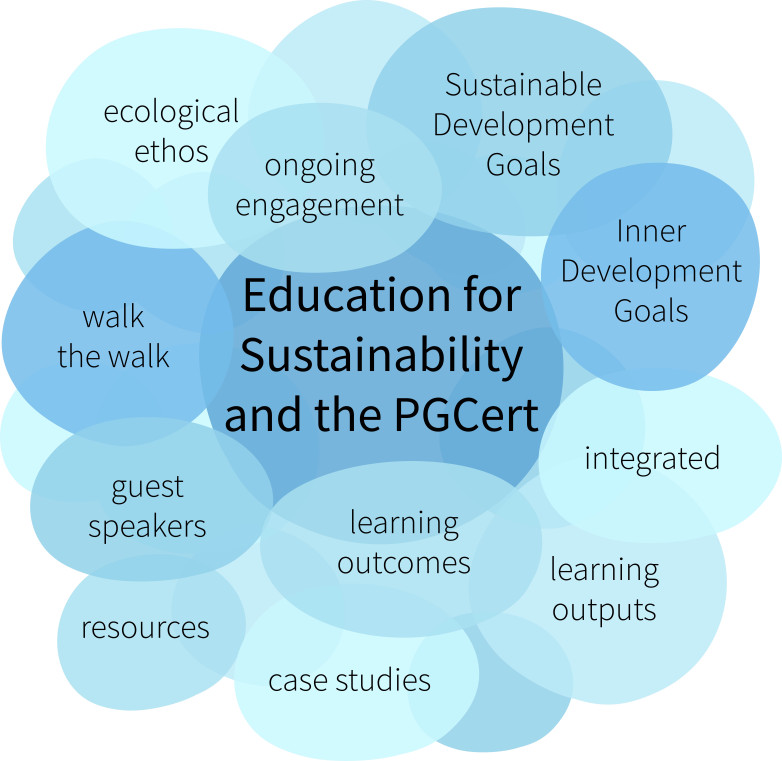
Fig 9.2 Some relationship between Education for Sustainability and the PGCert.
Despite these promising approaches, the journey of embedding EfS in PGCerts is an ongoing one. Key challenges remain, including securing consistent institutional buy-in, providing adequate resources for curriculum innovation, including continuously upskilling PGCert facilitators to navigate the complexities of interdisciplinary EfS. The ‘wicked problem’ nature of sustainability means there are no easy answers and our role as PGCert educators is to embrace and navigate this complexity in collaboration with participants.
Design Decisions Checklist for EfS and PGCert
1. Review and Map Learning Outcomes
Check your current PGCert learning outcomes. Identify where sustainability themes (e.g. SDGs) are already present or could be naturally integrated.
2. Audit Your Teaching Practices
Identify one delivery method or resource you use (e.g. handouts, digital tools) and consider how it could be made more sustainable or inclusive.
3. Curate or Share a Case Study
Bring one discipline-specific case study (from your own experience or published sources) that illustrates EfS in action.
Invite participants to reflect on or adapt it for their own context.
Quick Win: Resource Bank – Start a shared document or Padlet for EfS resources. Add one introductory and one advanced resource relevant to most fields.
Encourage participants to add their/further examples.
5. Plan for Ongoing Engagement
Schedule a follow-up touchpoint (e.g. a short online check-in or alumni email) to revisit EfS themes after the course/module ends.
Ask participants what support or resources would help them continue their EfS journey.
Chapter 9 Bibliography
Advance HE. (2024). Education for Sustainable Development: a review of the literature 2015-2022 (Dr Mira Vogel et al.). https://s3.eu-west-2.amazonaws.com/assets.creode.advancehe-document-manager/documents/advance-he/Education_for_Sustainable_Development_-_a_review_of_the_literature_2015_2022_1695725366.pdf
Barnett, R. (2018). The ecological university. Oxon and NY: Routledge.
Blessinger, P., Singh, A.and Rao, M.B. (2024) ‘Strengthening ESD in universities through cultural pluralism’, University World News, 30 March. Available at: https://www.universityworldnews.com/post.php?story=20240326134617650
Bryan, A. (2021). Academia, climate change, and the future: an interview with Kim Stanley Robinson. [Blog] Book Club, Available at: https://bryanalexander.org/book-club/academia-climate-change-and-the-future-an-interview-with-kim-stanley-robinson/
Bryant, P. (2021). Be more cockatoo: Learning design ecosystems for a post-crisis world. [Blog] Peter Bryant: Post Digital Learning. Available at: https://peterbryant.smegradio.com/be-more-cockatoo-learning-design-ecosystems-for-a-post-crisis-world/
Leal Filho, W., Trevisan, L. V., Pace, P. J., & Mifsud, M. (Eds.). (2025). Education for sustainable development: The contribution of universities. Springer.
Higgins, K. and Calvert, A. (2025) Education for Sustainable Development Curriculum Design Toolkit. Advance HE. https://s3.eu-west-2.amazonaws.com/assets.creode.advancehe-document-manager/documents/advance-he/Education_for_Sustainable_Development_Curriculum_Design_Toolkit_FINAL_1741962947.pdf
Inner Development Goals (2024) Available at: https://innerdevelopmentgoals.org/
Kukuczka, J. (Host). (2025, June 30). Curriculum for a Sustainable Future (No. 1) [Audio podcast episode]. In Curriculum Conversations. Academic Development Centre, University of Warwick. Available at: https://warwick.ac.uk/fac/cross_fac/academic-development/curriculumhub/podcast/
Macintyre, T., Tilbury, D., & Wals, A. (2025). Education and Learning for Sustainable Futures: 50 Years of Learning for Environment and Change. Routledge. https://www.routledge.com/Education-and-Learning-for-Sustainable-Futures-50-Years-of-Learning-for-Environment-and-Change/Macintyre-Tilbury-Wals/p/book/9781032727912
Meredith, A. (2022). How to teach sustainability. [Blog] WonkHE. Available at: https://wonkhe.com/blogs/how-to-teach-sustainability/
Morley, C. (2025) ‘Embodying V5 ‘Collaborate With Others to Enhance Practice’ in the redesign of the PGCAP at the University of Salford’, SEDA Blog, 15 January. Available at: https://www.seda.ac.uk/blog
Orr, D.W. (1992). Ecological literacy: Education and the transition to a postmodern world. Albany: State University of New York Press.
Pratt-Adams, S., Warnes, M., & Brown, E. (Eds.). (2025). Introducing Interdisciplinary Modules in Higher Education: Enhancing Sustainability and Student Employability (1st ed.). Routledge. https://doi.org/10.4324/9781003474593
Vogel, M., Parker, L., Porter, J., O’Hara, M., Tebbs, E., Gard, R., He, X., & Gallimore, J.-B. (2023). Education for Sustainable Development: A review of the literature 2015–2022. Advance HE.
Wals, A. E. J., & Jickling, B. (2002). ‘Sustainability’ in higher education: From doublethink and newspeak to critical thinking and meaningful learning. International Journal of Sustainability in Higher Education, 3(3), 221–232.
Wonkhe. (2024). The polycrisis needs you. https://wonkhe.com/blogs/the-polycrisis-needs-you/
Young, R. (2024). Future Disruptions for Australian Universities. NSC Futures Hub. https://www.education.gov.au/download/18241/accord-report-future-disruptions-australian-universities/37641/document/pdf